
The Quiet Casualty
Across more than two years of war, the soil, water and air of Gaza have become a casualty that rarely reaches the front page. Its recovery, the scientists warn, may outlast any ceasefire by decades.
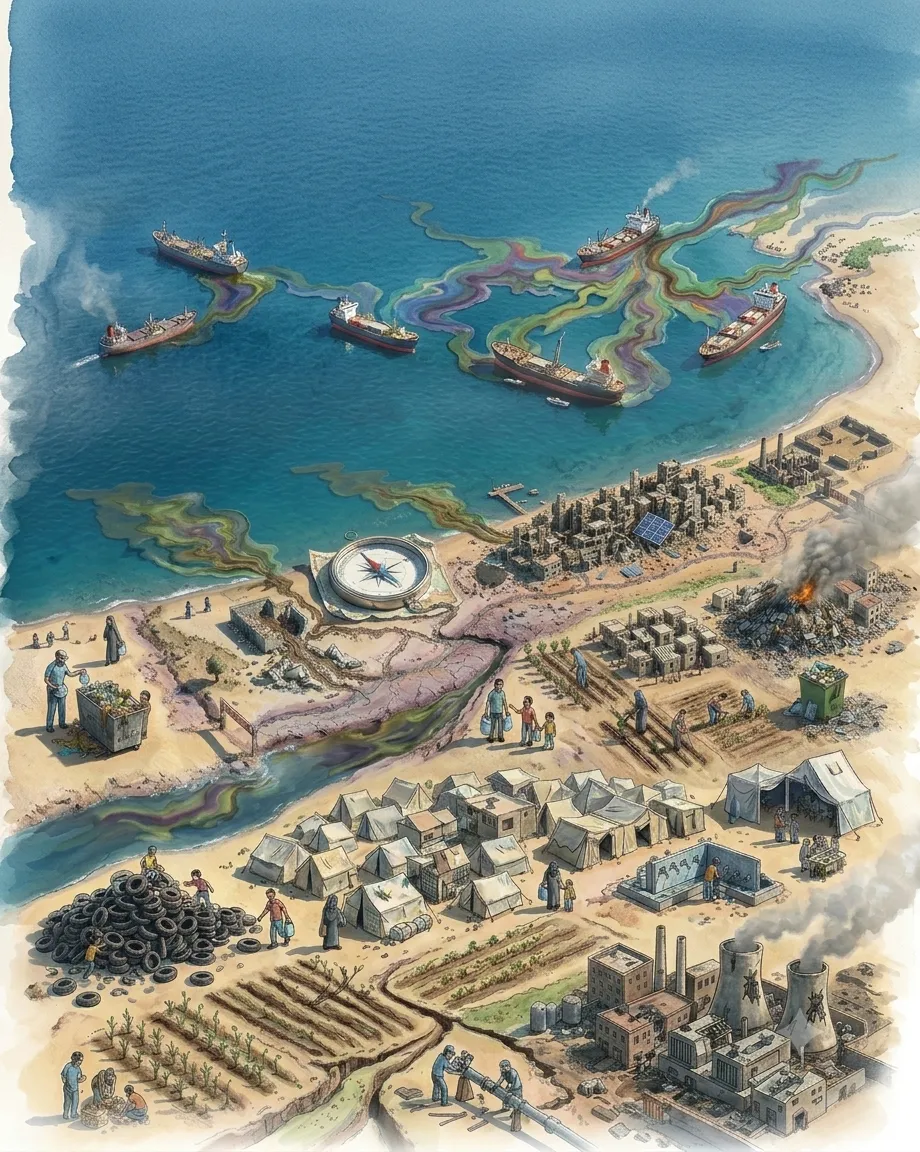
An environment does not recognize a front line. Two United Nations assessments now describe a landscape that any peace will inherit.
The war in Gaza began on 7 October 2023, when Hamas-led fighters crossed into southern Israel, killed roughly 1,200 people and took about 250 hostages. Israel’s military campaign followed, and more than two years on it has remade the territory in ways no ceasefire will quickly undo. Gaza had lived under an Israeli-Egyptian blockade since 2007, and UN agencies and many scholars treat that confinement and the wider occupation as part of why the territory was so fragile before the first strike, without lessening the immediate trigger. Beneath the human catastrophe lies a slower one, which two UN Environment Programme (UNEP) assessments have now tried to measure.
The damage did not begin on a blank page. Gaza presses more than two million people onto a sliver of coast in one of the most crowded and fastest-drying corners of the eastern Mediterranean. Its one source of fresh water, a coastal aquifer, was so overdrawn that by the eve of the war the UN judged more than 95 per cent of it unfit to drink. The prior years had brought modest gains too, among them new desalination plants, a spread of rooftop solar and the partial revival of the Wadi Gaza wetland. A Joint Water Committee created under the 1995 Oslo accords was meant to coordinate shared water, but Palestinians and outside critics long faulted it as lopsided, and it stalled. The tri-national group EcoPeace Middle East, founded in 1994, has for three decades argued that shared water is the region’s most solvable problem, not its most intractable.
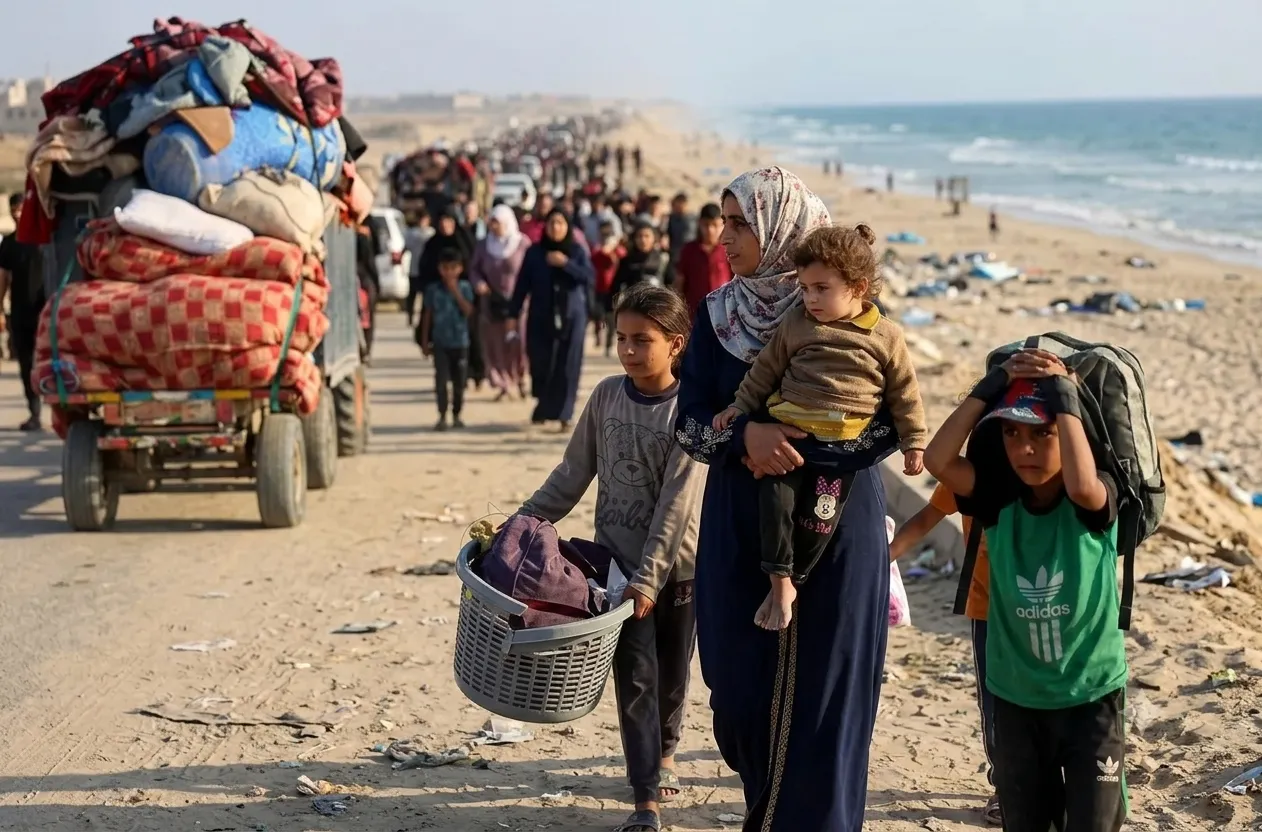
Gaza has been fought over before, in 2008-09, 2012, 2014 and 2021, and each left wreckage of its own, though the environmental cost was rarely tallied systematically. Even the most destructive, in 2014, drew assessments of ruined homes and infrastructure rather than a dedicated environmental audit. The clearest measure of how far this war departs from that history comes from UNEP, whose figures put its debris at roughly twenty times the total of every Gaza conflict since 2008 combined.
The first warnings came long before any formal survey existed. A November 2023 study from Harvard’s FXB Center for Health and Human Rights found that across all five of Gaza’s governorates, more than half of its healthcare, education and water facilities had been damaged in the war’s first six weeks. The systems a population leans on to stay healthy were failing before the rubble settled.
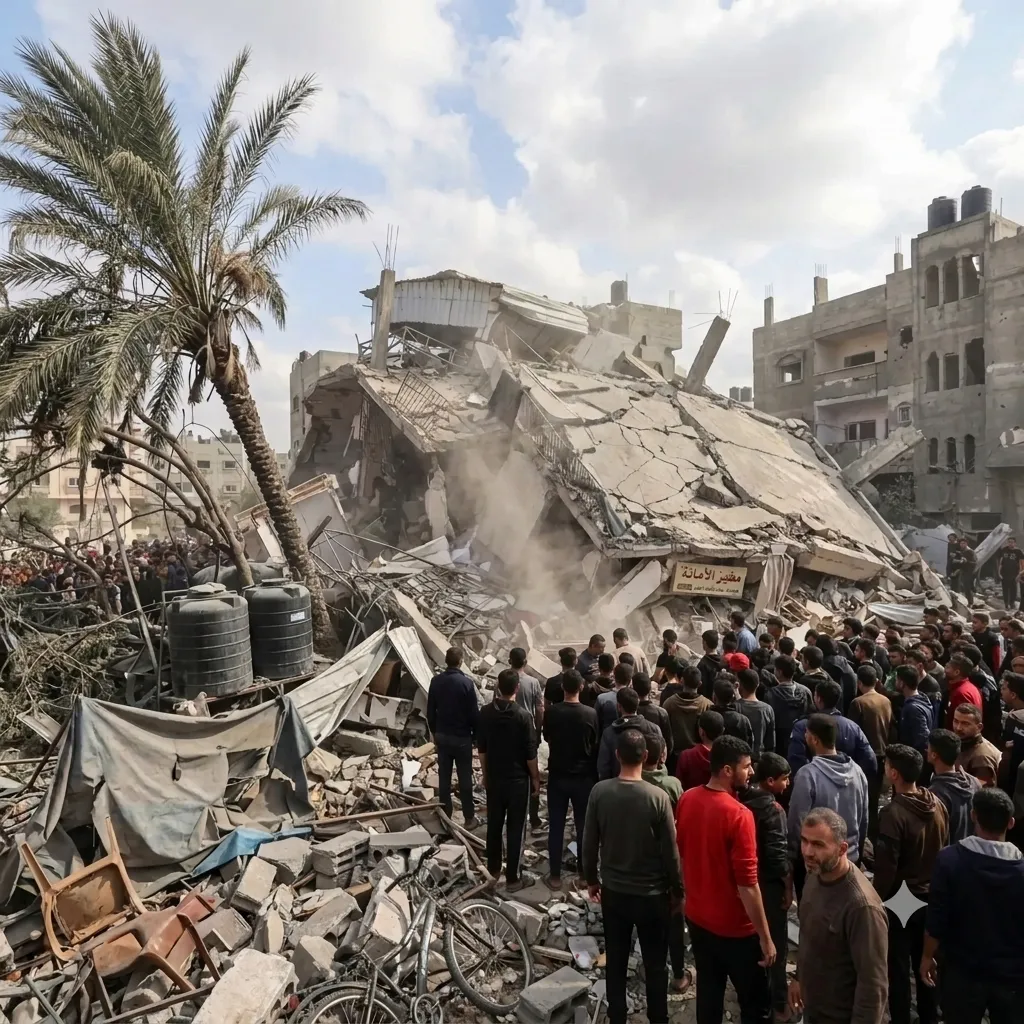
By the time UNEP published its second and fuller assessment, in September 2025, the damage could be sorted by the medium it occupied. On land, heavy machinery and lost vegetation had compacted the soil and stripped its cover, so that rain now runs off instead of refilling the aquifer, and UNEP warned of creeping desertification. In the air, the dust of pulverised concrete and the smoke of plastic and wood burned for cooking hang over a population with no working instruments left to measure what it breathes. In the water the picture is worst. The aquifer supplying almost all of Gaza’s drinking water is now judged likely contaminated, its sewage plants knocked out, untreated waste pushed into the ground and out to sea. UN health agencies tie the result to a steep rise in waterborne illness, cases of acute watery diarrhoea up roughly thirty-six times.
If that maps where the damage shows up, this traces what produced it. The largest cause is simply rubble. UNEP’s 2025 assessment put the share of Gaza’s buildings damaged or destroyed at about 78 per cent, leaving some 61 million tonnes of debris, by volume on the order of fifteen Great Pyramids. Buried in it is a second hazard, unexploded ordnance. The UN Mine Action Service (UNMAS) estimates that about a tenth of the munitions fired never detonated, leaving thousands of tonnes of live explosive, and warns that clearing the territory could take well over a decade. A third danger is chemical. UNEP judges that some 15 per cent of the debris may carry asbestos, industrial chemicals and the heavy metals freed when solar panels, vehicles and machinery are crushed and burned. The fourth, harm to living ecosystems, is the hardest to pin down, because the testing it would need cannot be done mid-war. Sewage now pours into the same Mediterranean where, a few years earlier, a brief respite brought back fish and even a rare sighting of the endangered monk seal. On wildlife, though, the data barely exists yet.
What can be done runs, in UNEP’s account, to thirty recommendations, and their ordering is itself an argument. Rebuild water and sewage first, because clean water saves the most lives. Test the soil before replanting. Recycle the rubble rather than bury it, and reuse treated wastewater to bring farmland and the aquifer back. UNEP’s own modelling suggests recycling even half the debris would cut total clearance costs by about a fifth, which is why it treats recycling as economics, not sentiment. The harder question is who pays. An international conference to fund recovery, led by Egypt and built around a reconstruction plan costed above fifty billion dollars, was due in Cairo late in 2025 and was postponed, after donors sought assurances, not yet given, against a repeat.
This would not be the first time the world has cleared up after a war. In Iraq, UNEP and the International Organization for Migration spent years on debris-recycling pilots in Mosul and Kirkuk, crushing the wreckage of the war against ISIL into aggregate that met national road standards and put local people to work. In Lebanon in 2006, after Israeli strikes on a coastal power station spilled thousands of tonnes of oil into the Mediterranean, a UN-led cleanup went ahead even as the fighting continued. Both prove the methods exist, and both show their limits. The Iraqi pilots handled tens of thousands of tonnes against a national total in the tens of millions, and Lebanon’s spill, for all the harm it did a shared sea, was a fraction of Gaza’s burden. The technique is proven. The scale is not.
That distance between what is possible and what is funded is one of three questions the recovery leaves open. The first is money. Pledges for Gaza have been large and loud, but pledges are not deliveries, and the Cairo postponement shows how fast the gap widens. The second is authority. Remediation needs someone to run it, to order soil tests, sign contracts and hold work to standards, and Gaza’s political future is unsettled. The third is the most seductive, and the one to handle with most care. It is tempting to say a shared environment forces cooperation, that a shared aquifer and a shared coast leave old adversaries no choice but to act together. The case usually cited is the Indus Waters Treaty, which kept water moving between India and Pakistan through decades of hostility. But India suspended it in 2025 after an attack in Kashmir, and it remained in abeyance in 2026, proof that even the sturdiest such arrangement can be revoked when the politics turn. Shared resources can create reasons to cooperate. They do not guarantee it.
The work itself then divides in two. Clearing rubble is the labour of years, and within reach. Reviving a poisoned aquifer or a felled orchard is the labour of a generation. Both fall, in the end, to whoever inherits Gaza. For the generation now in classrooms and conference halls, it may be among the hardest cases they are ever handed.
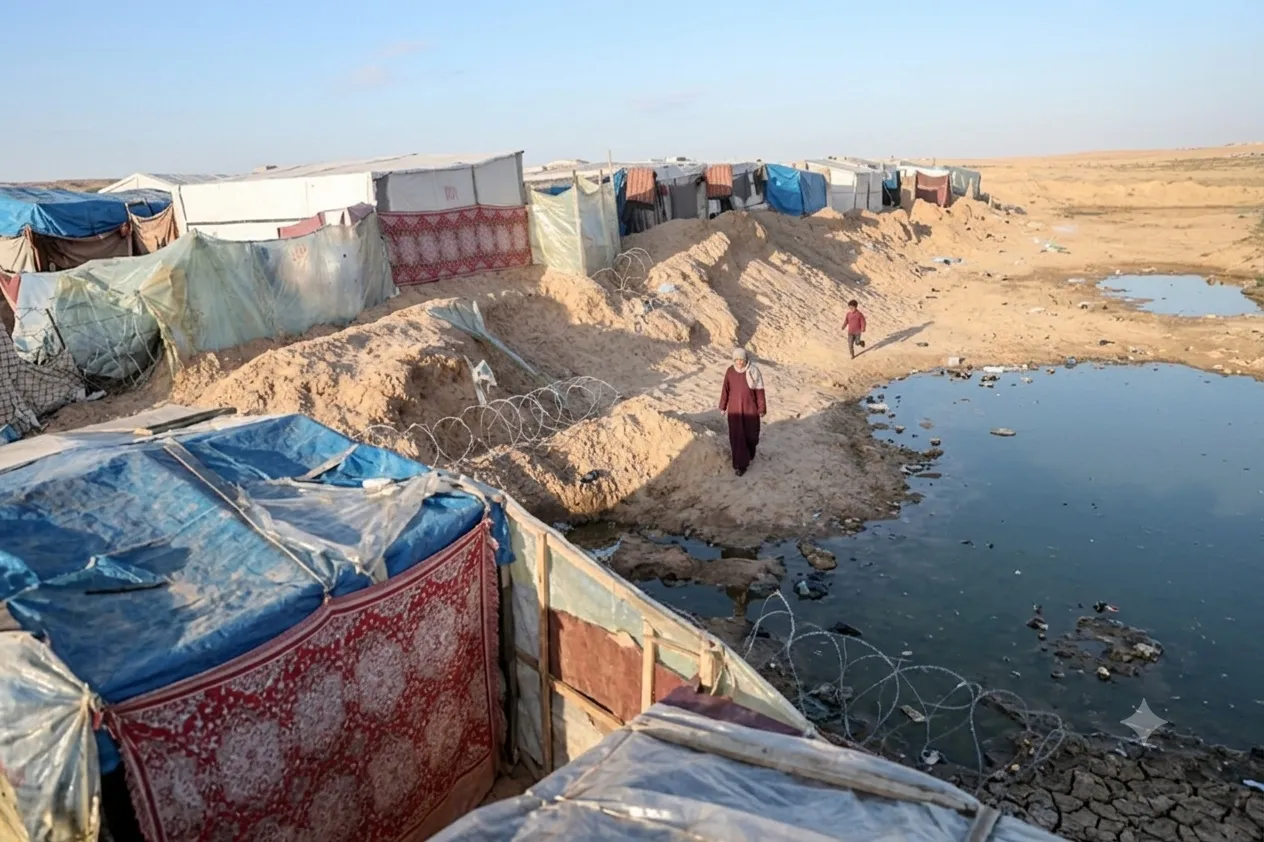
Two UN Environment Programme assessments have measured the war’s toll on Gaza’s soil, water and air, from some 61 million tonnes of debris to an aquifer judged likely contaminated. Their recovery, the United Nations warns, will be measured in decades rather than years.
You might also like
 Main Feature
The Most Polluting World Cup?
A neutral look at how travel and an ever larger tournament drive the carbon cost of the world's favourite game.
 Main Feature
A Covenant at the Edge of the Amazon
A dispatch from where the rainforest meets the communities who live by it and work to defend it.
 Feature
The Best Halls in Asia
Inside the campuses drawing the region's students, and the culture that comes with a place at them.